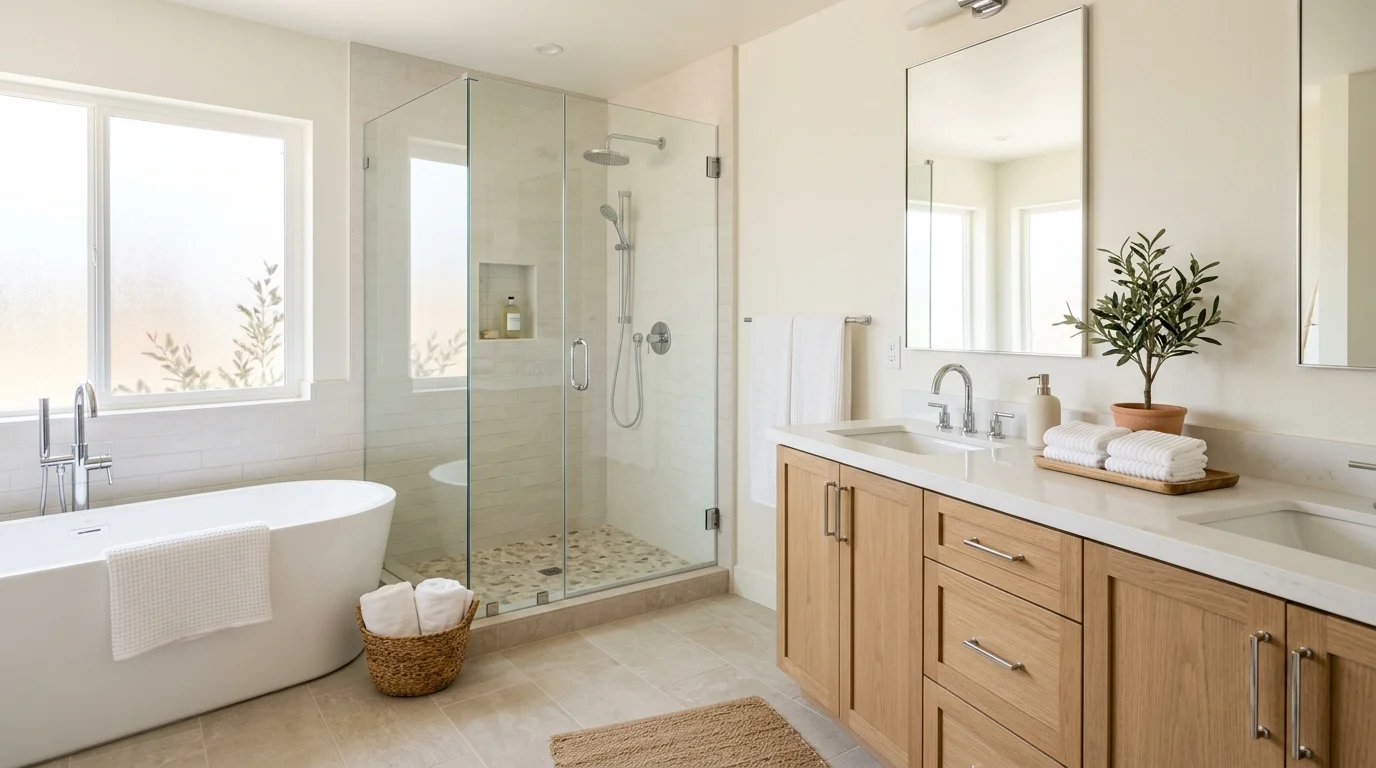
Fall listings in San Diego often stall on the bathrooms, not the view. Buyers walk a 1970s oak vanity in Clairemont the same week they walk a cracked tub surround in Otay Ranch, and they ding both. A bathroom remodel before selling in San Diego is a scoping call: what to fix, how far to go, and whether the job can finish before you list.
National recoup percentages could not be confirmed for this market. Treat them as marketing, not a plan. Ask your listing agent what competing homes show, then compare itemized bids from a licensed local pro. Bath Pro SD matches you with that pro. We do not remodel, list, or sell the house.
Refresh vs full remodel when the listing is months away
Time is the first constraint. If you plan to list in a few months, a tear-out that moves plumbing or opens walls can run past the photo date. A refresh that keeps the layout, swaps the vanity, retouches grout, and replaces tired fixtures can still photograph clean. The living-in-the-house version of this choice is different from the listing version. For the stay-put path, read bathroom refresh vs full remodel. For a sale, the test is simpler: will a buyer use this room against the price, and can the work be closed out before escrow starts.
A full gut makes sense when the bath is the obvious weak room in an otherwise ready house. Think a primary suite in a 1980s Scripps Ranch two-story, or the only full bath in a South Bay starter. If the shower leaks, the surround is delaminating, or the floor is soft at the toilet, paint will not hide it. Inspectors and buyers both find water. Cosmetic work on a wet wall is a gift to the appraisal contingency.
A refresh makes sense when the bones work and the finishes just look tired. Neutral paint, a current vanity, matching metal, a working exhaust fan, and a shower that does not smell like mildew. That is often enough in East County tract homes where buyers already expect a next-step update. Overbuilding a spa primary in a house that still has original windows and a dated kitchen rarely helps the listing. It just spends calendar time you do not have.
If the room that actually sets the listing photos is the primary, scope a master bathroom remodel against the rest of the house, not against a magazine. If every bath in the home is the same vintage and the same problem, a full bathroom remodel on the worst one, plus a lighter refresh on the others, is usually the cleaner story. Do not start two open jobs if you need one finished room for showings.
Ask the listing agent for three nearby solds and three actives, then walk those bathrooms in person if you can. Match the level you see, not the level you would build for yourself. Pre-sale bathroom updates should look finished and ordinary for the block. They should not look like a personal passion project that a buyer has to undo.
What coastal buyers vs inland buyers actually ding
San Diego County is not one taste. A La Jolla or Del Mar buyer walking a primary bath expects quiet finishes, a working shower, and nothing that fights the light. Cheap plastic surrounds, honey oak, and mixed metals read as deferred work, even when the plumbing is fine. Encinitas, Solana Beach, and Carlsbad listings sit in the same coastal band. Salt air and hard water already mark fixtures. Buyers there ding corrosion, clouded shower doors, and silicone that has failed at the tub deck. They are less patient with a “we’ll credit you” story on a seven-figure street.
Inland North County is a different walk. Escondido, San Marcos, Vista, and Poway buyers still care about a clean bath, but they ding function first: low pressure, a fan that does not move air, a tub-shower that cannot be cleaned, a vanity with no storage. A luxury stone shower that overshoots the rest of a 1970s ranch can make the house feel unfinished everywhere else. Keep the work in line with the kitchen and the floors.
East County and the South Bay are more direct. El Cajon, Santee, Lakeside, and Alpine homes often still have original oak, gold trim, and builder tub surrounds. Chula Vista and National City tract baths get used hard by families. Buyers there ding stains, missing caulk, peeling surrounds, and a half-done tile job more than they ding a lack of spa features. A working, bright, easy-to-clean room sells. A custom layout that is still in progress does not.
Do not copy a coastal primary into an inland tract and call it value. Do not leave a coastal listing with a gold faucet set because “the bones are good.” Walk the comps on your side of the county. Coastal north county, inland north county, the central city, East County, and the South Bay do not share one buyer. The room that photographs well in Mission Hills can look overdone in Spring Valley and underdone in Bird Rock. Match the street.
Dated oak vanities, worn tub surrounds, and gold fixtures
Those three items are the San Diego tell. Honey oak vanities from the late 1980s and 1990s still sit in Clairemont, Mira Mesa, Rancho Peñasquitos, and a lot of East County stock. They photograph orange. They make a white toilet look dingy. Replacing the vanity, top, and faucet as a set is often the highest-visibility move in a pre-sale bathroom remodel. Painting oak in place can work if the box is sound and the color is quiet. It fails when the laminate top stays gold-flecked and the hardware stays mixed.
Worn tub surrounds are the next ding. Acrylic and fiberglass kits in 1990s South Bay and inland tract homes crack, stain, and pull at the corners. Buyers assume water behind the wall, whether that is fair or not. A refinish can buy you a listing photo if the pan is solid and you have almost no time. A surround that moves under a hand needs a licensed remodeler, not another coat of coating. Do not leave a flexing wall in a house you are asking someone to finance.
Gold faucets, fan lights, and oak-matched mirrors complete the dated set. Mixed metals in one small room read as leftover parts. Match the finish across faucet, shower trim, towel bar, and cabinet pulls. Brushed nickel and matte black both show up in current listings. Pick one and stop. This is not the moment for a statement fixture that a buyer will unscrew on day two.
None of this requires a layout change. Layout changes are how a three-month listing plan becomes a six-month construction plan. Keep the toilet, shower, and sink on their current stacks unless the room cannot function. Moving fixtures is a different job, with a different permit path, and it is a poor fit for a house that needs to go live this season.
If you only have budget for one room, pick the bath that appears in the listing photos and the one buyers will use during the showing. That is usually the primary, or the hall bath in a three-bed tract. A powder room can wait for paint and a new faucet. A leaking shower cannot wait.
Permits and unfinished work that stall escrow
Unfinished bathrooms stall deals. Open walls, missing trim, a vanity sitting in the garage, and a shower pan with no door all photograph as risk. Buyers, inspectors, and lenders look for work that started and never closed. A credit in escrow does not always fix that. Some buyers will not write. Some lenders will not fund around an open building permit. Confirm the current practice with your listing agent and with the department that issued the permit. Do not guess.
In the City of San Diego, bathroom remodel permits run through Development Services. Whether your specific job needs a permit depends on scope, and a public trigger list for this page could not be confirmed. Ask the licensed pro and the city before anyone opens a wall. In unincorporated communities (Ramona, Valley Center, Alpine, Lakeside, Spring Valley, Fallbrook, Bonsall, Hidden Meadows, and the rest of the unincorporated county), building permits go through County Planning & Development Services, not the city. Incorporated cities (Poway, Del Mar, Solana Beach, Encinitas, Santee, El Cajon, Chula Vista, Escondido, Oceanside, Carlsbad, Vista, San Marcos, La Mesa, and the others) run their own building departments. Look up your own jurisdiction. Do not assume the city process applies to a county parcel, or the reverse.
Skip the permit when one is required and you create a problem that follows the house. Unlicensed contracting in California is a misdemeanor under Business and Professions Code section 7028, unless an exemption applies. The small-job exemption under section 7048 is narrow: the aggregate contract price for labor, materials, and all other items must be less than $1,000, the work must be casual or minor, and it must not require a building permit. Both the dollar cap and the no-permit condition have to hold. The $1,000 threshold is effective January 1, 2026. Splitting a job into smaller contracts to dodge licensing is excluded. Anyone who advertises as a contractor loses the exemption at any price. Check the person you hire on the CSLB license lookup.
Close the job before you list when you can. Final inspection, fixtures set, caulk cured, and the room usable. A “we’ll finish during escrow” plan is how a fall listing becomes a winter listing. If the work cannot finish, pause the listing or keep the scope at a refresh that does not open a permit file you cannot close.
How to scope a pre-sale job with a licensed local pro
Start with the listing date and work backward. Tell the remodeler the photo day, not a vague season. Walk the room with three piles: must fix (leaks, soft floor, failed surround, broken fan), should update (oak vanity, gold trim, stained caulk), and leave alone (layout, tile that is dated but intact, a second bath that already looks consistent). Bid the must-fix pile first. Add the should-update pile only if the calendar and the comps support it.
Get itemized bids, not a single lump number. You need to see fixtures, waterproofing, electrical, and labor as separate lines so you can cut without gutting the wet work. Home improvement down payments in California cannot exceed $1,000 or 10 percent of the contract amount, whichever is less. On a larger job the cap is $1,000, not 10 percent. Read the contract. Confirm the license on CSLB. Bath Pro SD connects you with licensed independent pros. We do not pull permits, set tile, or hold the warranty. The matched remodeler does the work.
Do not use a national “30 percent of home value” remodeling rule as your cap. That figure is not in our verified claims and could not be confirmed for San Diego. Your listing agent and recent comps are the local check. Typical job-cost averages for a San Diego bathroom also could not be confirmed for this page. Compare bids, then read bathroom remodel cost in San Diego for how scope drives price, not for a promised return.
Should you remodel the bathroom before selling. Yes when the room is the obvious objection and you can finish it. No when the house will sell on lot, school, or view, and the bath is dated but dry. Selling as-is is a pricing decision, not a moral one. Price the condition you actually have. A half-finished primary is the worst of both: you spent the money and you still look unfinished.
Keep finishes quiet. White or light tile, a simple vanity, one metal, clear glass if the shower is new. Coastal listings can handle a slightly more tailored material, still in a calm palette. Inland and South Bay listings do better with clean and durable. The goal is that a buyer can move in without putting the bath on a punch list in week one.
When to call us
Call when the bath is the room that will lose you a bid, and you need a licensed local remodeler to scope a finishable job before you list. Call before anyone opens a wall, and before you promise a buyer that work will be done in escrow. Call us at (858) 400-4896 and we’ll connect you with a licensed local bathroom remodeler.