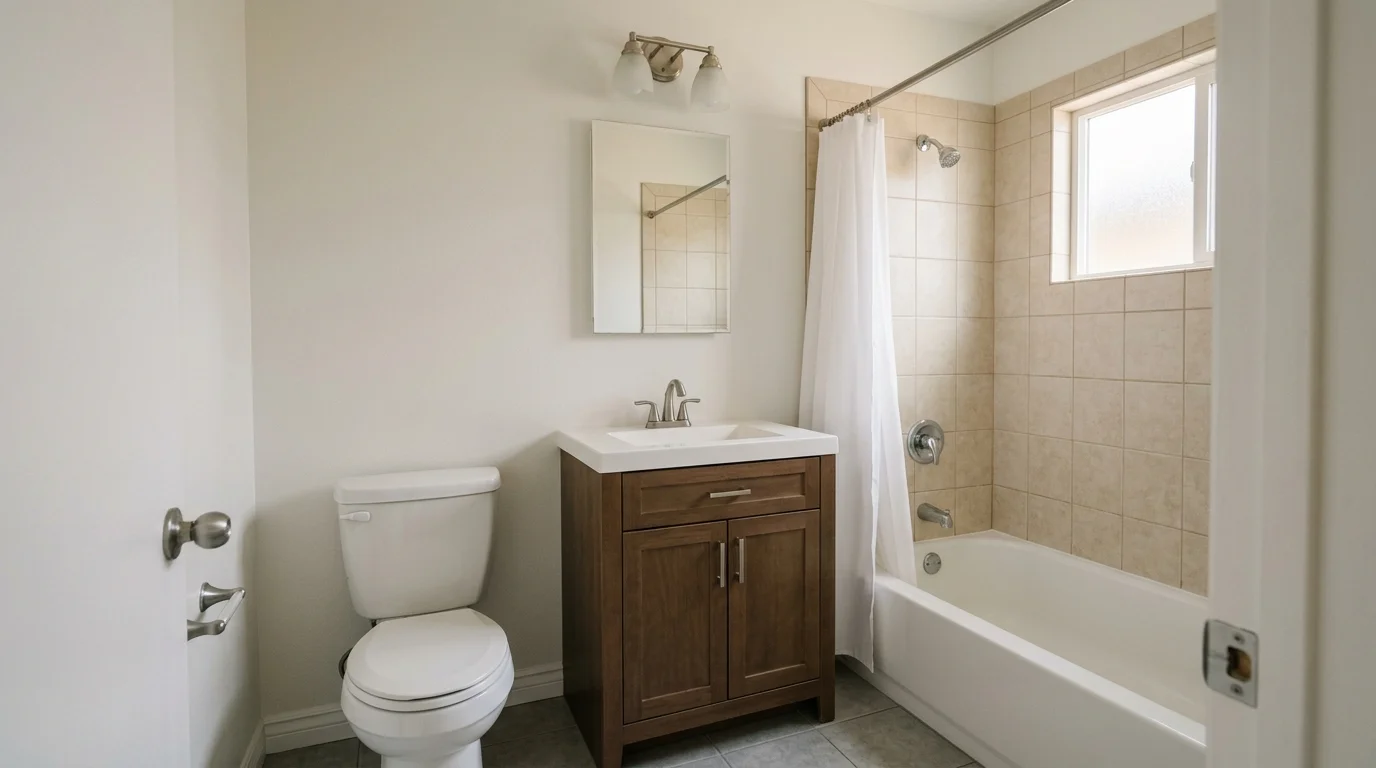
A South Bay two-bed hall bath and a Mission Valley condo bath fail in different ways. One takes kids, stained grout, and a peeling tub surround. The other takes roommates, a tiny wet area, and an HOA that cares how debris leaves the building. A rental bathroom remodel in San Diego is a turnover problem first. You are buying surfaces that survive the next lease, not a spa for one owner.
Bath Pro SD matches landlords with licensed independent local bathroom remodelers. We do not manage rentals and we do not perform the work.
What tenants actually break, stain, and flood
The damage pattern in a rental is boring and expensive. Caulk fails first. Then the tub surround. Then the vanity top. Then the floor at the toilet base.
Tenants hang shower caddies on cheap bars. They chip the enamel on a 1970s tub in Chula Vista. They leave hair dye on a cultured-marble top in National City. They never run the fan, or the fan is already dead, and the paint at the ceiling line bubbles. None of that is exotic. It is what a hall bath sees when it is the only wet room in the unit.
Floods are the ones that eat a weekend. An overflowing tub. A toilet that ran because the flapper died. A shower pan that was already cracked, then someone stood on it for a year. In an upstairs Mission Valley condo, that water does not stay in your unit. It finds the neighbor, the HOA, and the insurance file.
Older South Bay tract baths often still have the original fiberglass surround and a builder vanity with a particleboard box. Once the sink leaks, the box swells and the doors stop closing. You can paint the walls and swap the faucet. You cannot paint a swollen box back into square. Oceanside coastal rentals add salt air on top of tenant wear. Cheap metal shower doors stain. Hardware pits. Window trim in the wet zone fails if it was never detailed for moisture.
Walk the unit before you pick a finish board. Look at the caulk lines, the pan, the toilet flange, the vanity box, and the floor under the toilet. Press the pan. If it flexes, the wet area is the job. If the vanity doors will not close, the cabinet is the job. If those pieces are shot, a paint-and-hardware refresh will not hold through the next lease. That is the real line between a cosmetic reset and a full bathroom remodel.
You will not get a verified countywide list of “what every tenant breaks.” Housing stock is not one thing from San Ysidro to Oceanside. A National City two-bed built in the 1960s does not wear like a newer stacked condo off the 8. Spec the room you own, not a generic rental bathroom.
Finishes that clean up between occupants
Landlords do not need boutique tile. They need surfaces a cleaner can reset between occupants without refinishing the room.
Large-format porcelain on the floor is easier to mop than a busy mosaic. Dark grout hides less than people think. It still stains, and then you cannot see what you missed. A mid-tone grout that shows dirt is easier to clean on turnover day. Keep the pattern simple so a future pro can patch a cracked piece without a scavenger hunt.
Shower walls are where rentals die. Grout-heavy subway layouts look fine in photos and age badly with soap and San Diego hard water. Low-maintenance shower walls matter more here than in an owner-occupied primary bath. Solid-surface panels, well-detailed large tile with fewer joints, or a quality acrylic surround all beat a maze of grout. None of them is magic. The install still has to be waterproofed correctly, or the pretty wall is just a lid on a leak.
Vanities take the sink leak, the kicked door, and the cleaner’s spray. A stock box with a quartz or solid-surface top beats a cheap cultured-marble top that etches and stains. Soft-close hinges are nice. Replaceable stock doors are nicer when someone puts a boot through one. Skip the floating vanity in a rental unless you like repairing the wall behind it after the first heavy lean.
Fixtures should be common. Chrome or another finish you can replace from a supply house, not a custom line that takes months. Single-handle faucets are simpler for tenants. A standard toilet, so a plumber can swap it without hunting a discontinued model. Mirrors and lighting should be hard to knock off the wall. Medicine cabinets with weak clips get ripped out.
None of this is a lifespan guarantee. We do not publish year counts for materials, and we do not publish a starting price for this brand. The test is turnover: can someone wipe the room down, recaulk what needs it, and rent it again without opening the walls.
If the wet area is sound and you only need paint, a toilet, and a vanity swap, you may still be in refresh territory. If the pan, surround, and floor are done, stop pretending a refresh will hold. Compare the damage against a refresh versus a full remodel before you write the scope.
Tubs vs showers in a two-bed rental
A two-bed rental in Chula Vista or National City often houses a family. A tub is still the practical bathing option for small kids. Rip it out because walk-in showers photograph well, and you can shrink the tenant pool that can actually use the unit.
A one-bath condo in Mission Valley or a stacked unit in Oceanside is a different product. Couples and roommates often prefer a shower. The footprint is tight. A tub eats the room and makes the door swing worse. A small bathroom remodel in those buildings is usually a shower-forward plan with a stock vanity that clears the door.
Do not treat tub-to-shower as an automatic upgrade. Treat it as a tenant-mix decision. If you keep the tub, specify a surround that can take cleaners and hanging caddies without peeling. If you go shower, keep the pan and walls easy to inspect. A hidden leak in a rental is a call from downstairs, not a polite note on the counter.
HOAs in Mission Valley and many Oceanside condos may control finishes, work hours, and how debris leaves the building. Confirm the association rules before anyone opens a wall. Occupied or vacant, the building still has a process. The licensed pro can plan protection in the hallway. You still have to get the written approval the association requires.
We do not publish a verified cost for either path. Search results will throw round numbers at you. Five thousand, ten thousand, a 30 percent rule. None of those figures is in our verified claims file, and none of them is a scope. Scope is the wet area, the vanity, the floor, and whether plumbing stays on the current rough-ins. A written bid from a licensed pro is the number that matters, not a blog average.
Keep the rest of the room honest. A spa shower in a two-bed rental hall bath is a maintenance plan you will own at every turnover. Simple, wipeable, and standard-sized is the rental spec.
Permits still apply when the unit is occupied
A tenant in the unit does not cancel the permit rules. Whether a bathroom job needs a permit still turns on scope. We do not publish a trigger list or a fee, because those were not verified for this site. The licensed pro and the building department set that call. Guessing from a blog checklist is how a job gets red-tagged.
Inside the City of San Diego, including Mission Valley, permits run through Development Services. Unincorporated communities go through County Planning and Development Services. Chula Vista, National City, and Oceanside are incorporated cities with their own building departments. Look up the address. Do not assume the City of San Diego covers a National City duplex or an Oceanside condo.
California contractor law still applies on a rental. Work is exempt from licensure only when the aggregate contract price for labor, materials, and all other items is less than $1,000, the work is casual or minor, and it does not require a building permit. Both the dollar cap and the no-permit condition have to hold. The $1,000 threshold is the current figure, effective January 1, 2026. The $500 figure still repeated across the web is stale. Splitting a job into smaller contracts to dodge licensing is not allowed. Anyone who advertises as a contractor loses the exemption at any price. Unlicensed contracting is a misdemeanor under state law.
On a home improvement contract, the down payment shall not exceed $1,000 or 10 percent of the contract amount, whichever is less. On a larger job that cap is $1,000, not 10 percent of the total. Put the payment schedule in the written contract. Check the license on the CSLB license lookup before anyone demos a surround.
Occupancy, notice to enter, and habitability during the work are landlord-tenant questions. Specific statute numbers and day-count notice rules for that were not confirmed in our claims file. Confirm them with a California landlord-tenant attorney and with the local building department before you schedule demo in a live unit. If the bathroom is the only one in the unit, plan how the tenant bathes and uses a toilet while the room is down. That logistics plan is yours. We do not manage rentals, and the matched pro is the one who does the physical work.
Scoping a durable job with a licensed local pro
Start with what failed, not a finish board. If the pan, surround, and vanity box are done, you are past a refresh. Keep fixtures on their current rough-ins when you can. Moving a toilet or tub in a small rental hall bath adds cost and inspection scope you may not need. The durable win is usually the wet area and the floor.
Put durability in the contract in plain language: shower walls, pan, waterproofing, vanity spec, fixture spec, and who pulls any permit the department requires. Licensed is the word that matters. We match you with licensed independent local pros. We do not hold the trade license, we do not pull the permit, and we do not warrant the work. Only the matched pro is licensed, and only that pro’s work is warrantied.
A South Bay two-bed and a Mission Valley condo should not get the same spec sheet. The two-bed wants a tub that can take kids and a floor that mops. The condo wants a tight shower, HOA-legal finishes, and a plan for protecting common hallways. Ask the pro to walk the unit type you actually own, in the city it actually sits in.
Skip the 30 percent remodeling rule you will see in generic articles. We could not confirm a California statute or San Diego code that sets it. It is not a permit rule. It is marketing talk. Same for any published average cost, rent lift, or payback year. Those were not verified here, so they do not belong in the scope.
Bring the lease calendar, the HOA packet if there is one, and photos of the damage. Tell the pro it is a rental. The job is to last through turnover, not to win a design contest.
When to call us
When the hall bath is staining between every lease, or the pan is already soft, it is time for a licensed bathroom remodeler, not another tube of caulk. Call us at (858) 400-4896 and we’ll connect you with a licensed local bathroom remodeler. Tell them it is a rental, name the city, and say whether a tenant is in place.