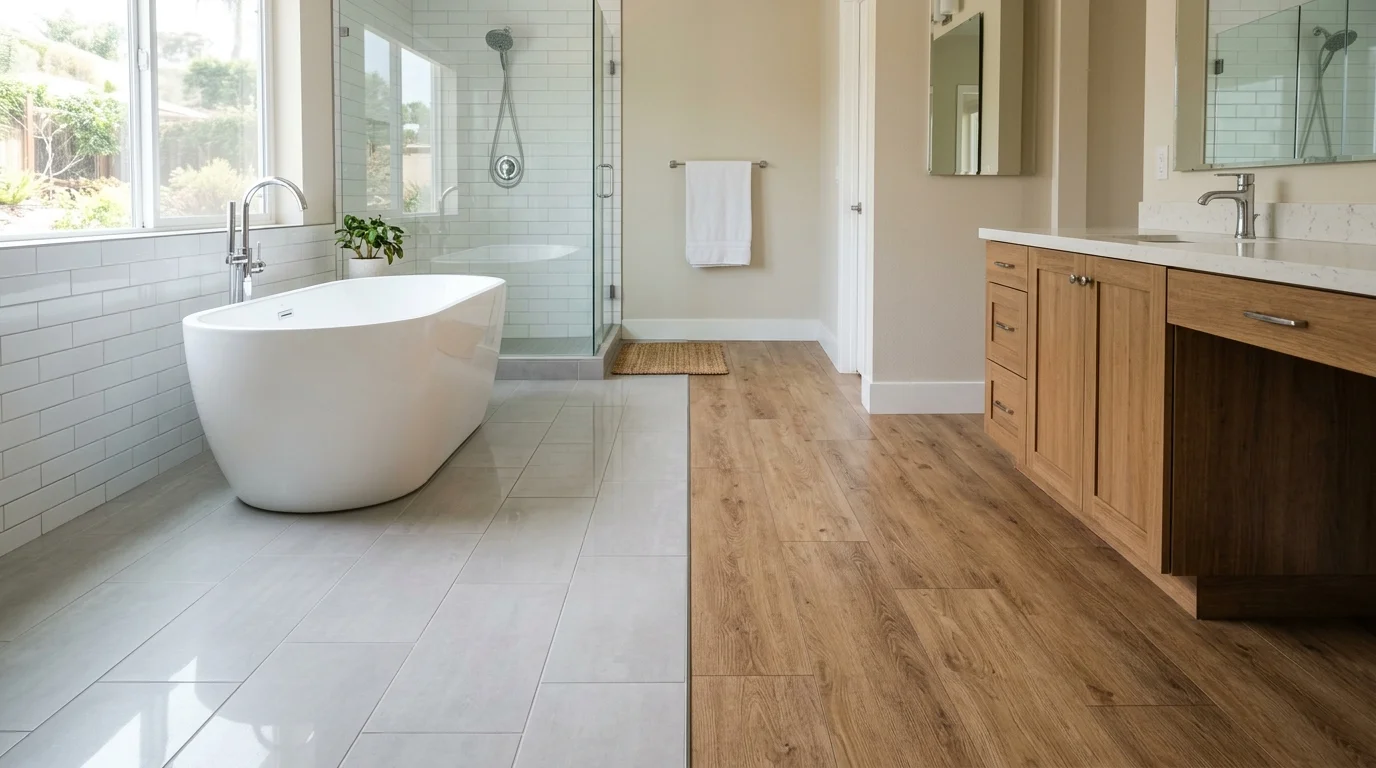
Two bids, one bathroom, two different floors. One line is tile. The other is vinyl plank, vinyl tile, or a sheet rolled through the wet room. The tile vs vinyl bathroom floor call in San Diego turns on the shower, the slab, and whether you live in marine air or inland heat.
Where tile still earns its keep on a bathroom floor
Tile is the floor you pick when water is going to sit, not just splash. Inside the shower, at a curb, and around a tub that can overflow, a tiled floor still belongs in a hard-wet assembly. The walking surface is fired ceramic or porcelain. Grout and a membrane do the sealing work. That is a different system than a floating vinyl floor, and it is the system most licensed remodelers still want next to a pan.
A Pacific Beach condo bath is the local version of that job. Many of those buildings sit on an on-grade slab. The room is small. Steam from a long shower has nowhere to go, and a leak does not stay in your unit. Tile set over a waterproofed floor is the conservative finish at the wet box. You can run the same tile onto the dry field, or keep the field quieter and tile only the shower. The shower floor itself is almost never vinyl.
Tile also earns the work when you want a floor you can repair in pieces. One cracked field tile can come out. A gouged vinyl plank often means unlocking a run of planks, or cutting a patch that never quite disappears. That matters in a family bath where bottles drop and the toilet gets pulled more than once.
Grout is the tradeoff. It needs cleaning. Some grouts stain. Confirm the grout type with the installer. Do not assume a sealer schedule, a lifespan, or a maintenance-free claim. None of those figures are confirmed here, and manufacturer marketing is not a standard.
Hard underfoot is real. Tile is cooler than vinyl on a January morning in Mission Hills, and it is cooler still on an on-grade slab. If you want warmth under the finish, that is a separate assembly. Read heated bathroom floors in San Diego for that path, then confirm with the installer which floor finish is listed for a heated system. Do not assume vinyl is.
If you still need help choosing a body, glaze, or size, that is a buying decision, not this one. Our bathroom tile buying guide covers porcelain, ceramic, and stone. For the floor of a wet room, start with bathroom tile and flooring and treat vinyl as the alternate, not the default.
Where vinyl sheet or plank is the better floor
Vinyl plank in a bathroom shows up for comfort, a wood look without wood, and a faster field install. Sheet vinyl still shows up in guest baths and rentals because it has far fewer seams. Neither one is automatically the cheap shortcut. Quality varies by product. Confirm the SKU is listed for wet areas. Confirm the method: floating click-lock, glue-down plank, or full-spread sheet.
Vinyl is often the better floor when the bath is a powder room or a lightly used hall bath, the shower is contained, and you want something quieter under bare feet. A small bathroom remodel in a Clairemont or North Park bungalow is a common case. The room is tight. A floating vinyl floor can live with a slightly imperfect subfloor that would fight large-format tile. That is a prep question, not a style question.
Sheet vinyl vs tile in a bathroom is a different comparison than bathroom floor tile or LVP. A well-sealed sheet has almost no joints on the field. Plank has a joint every few inches. Standing water at those joints is the risk people worry about. Mold does not grow because the floor is vinyl. Mold grows when moisture sits on dust, paper, wood, or drywall under the finish. If water gets under a floating floor and stays, you have a problem. If the sheet is fully adhered and the edges are detailed, you have a different risk. Ask how the tub, toilet flange, and door get sealed. Do not accept “it’s waterproof” as the whole answer.
Downsides of vinyl tile and plank are real. Heavy furniture can dent it. Sun through a west window in El Cajon can fade a cheap print. You cannot sand it. A damaged plank is a replacement, not a refinish. Some floating floors sound hollow. Those are product and install issues. Compare the actual listing on the bid, not a category name, and have the installer walk the wet-area rating with you before anyone orders material.
Slabs, moisture, and inland heat vs the marine layer
San Diego County is not one climate. A Pacific Beach condo slab and an El Cajon ranch on grade ask different things of a bathroom floor.
Pacific Beach, Mission Beach, and La Jolla sit in marine air. Salt, fog, and daily humidity load the room even when nobody showers. Condos often stack baths over baths. Tile in a membrane assembly is the conservative pick next to the shower. Vinyl can still work in the dry field if the shower is a contained pan and the doorway is detailed. Confirm HOA rules before you change a floor finish. Some associations care about sound and stack height, not just looks.
El Cajon, Santee, and Lakeside run hotter and drier most of the year. A ranch on grade often means a slab with little or no crawl space, big west glass, and a hall bath that bakes in the afternoon. Vinyl can feel better on that slab in August. Tile can feel like a patio. Heat also works against some vinyl. Confirm the product’s temperature listing with the installer. Do not guess a maximum, and do not copy a number from a national roundup.
On-grade slabs can carry moisture from below. That is a building question, not a style one. A floating vinyl floor over a damp slab can trap vapor. A tile assembly can trap it too if the wrong membrane is used. Neither material solves a wet slab. Ask the remodeler how they tested the slab and what the manufacturer requires. If they cannot name the test, keep shopping.
Inland nights cool off. Coastal nights often do not. That swing is why a floor that is fine in a Point Loma guest bath can behave differently in Alpine after a summer. Expansion gaps on a floating vinyl floor are not optional. Tile wants a stable substrate. The licensed pro you hire should say which one your house actually is.
If the job is inside the City of San Diego, permits go through Development Services. Unincorporated communities go through County Planning and Development Services. Incorporated cities run their own departments. Whether a floor-only swap needs a permit depends on scope. That trigger list is not confirmed here. Ask the building department that covers your address.
Transitions at the shower curb and the hallway
The floor decision is often a transition decision. Three lines matter: shower to bath floor, bath floor to hallway, and the toilet closet if you have one.
Do not run a floating vinyl plank through a shower. The curb, the pan, and the slope are a waterproofing job. Tile, a solid-surface base, or another listed wet-area system belongs there. Vinyl can meet the curb, but the meeting has to be drawn: a reducer, a metal edge, a sealant joint that can be recaulked. Ask to see that detail, not a hallway sample.
Hallway transitions are the other fight. Many San Diego homes have vinyl or wood-look floors in the hall and want the bath to match. Matching the look with wood-look porcelain is one path. Running the same vinyl into a powder room is another. Mixing them at the door is fine if the heights match. A proud tile lip at a narrow bath door is a trip. Measure finished floor height, not just the sample in the box.
In a condo, stacking and sound matter. A mud-set tile floor is thicker than a thin vinyl plank. That can change the shower curb height, the toilet reset, and the door undercut. In a ranch, the issue is more often a bath slab that sits below the hall, or a hallway that was floated years ago. Either way, the transition is labor. It should show up as a line item, not a handshake.
Wood-look vinyl plank is what a lot of bids lead with right now because it matches the rest of the house. Large-format porcelain is what a lot of wet-room bids still close with. Neither one is a trend you have to follow. Pick the finish that belongs at the curb, then decide whether the dry field should match it.
How to read two floor quotes without a made-up average
Ignore any page that quotes a per-square-foot average for tile vs vinyl in San Diego. Those figures are not confirmed here. They hide the labor that actually moves the number: demo, leveling, waterproofing, transitions, toilet reset, and whether the shower floor is in the same bid.
Ask for two itemized bids on the same scope. Same room. Same demo. Same waterproofing. Then change only the finish.
On the tile bid, you want the product name and size, mortar, membrane, grout type, floor prep, shower curb detail, and who owns the waterproofing if something fails. On the vinyl bid, you want the product name, the wet-area listing, the install method, underlayment, edge seal at the tub, and what happens if a plank fails. If a wear layer or warranty year is printed on the spec sheet, read it there. Do not take a round number from a blog, including this one.
The California deposit cap on a home improvement contract is $1,000 or 10 percent of the contract amount, whichever is less. On a large bath job the cap is $1,000, not 10 percent of the total. Check the contractor on the CSLB license lookup. Unlicensed contracting is a misdemeanor. Work is only exempt from the license requirement when the aggregate contract is under $1,000, the work is casual or minor, and no permit is required. Splitting a job to stay under that line does not count. Bath Pro SD does not install floors, pull permits, or hold a contractor license. We match you with licensed independent pros.
If the two bids are far apart, the gap is usually prep, not the tile box. A Pacific Beach slab that is already flat is a different job than an El Cajon ranch with a cracked, out-of-level hall. Make them walk the room. Then pick the floor that matches the wet zone, not the one that won a national comparison.
When to call us
When the floor sits next to a shower, a tub, or a slab you cannot see, you want a licensed bathroom remodeler reading the room, not a product brochure. Call us at (858) 400-4896 and we’ll connect you with a licensed local bathroom remodeler.