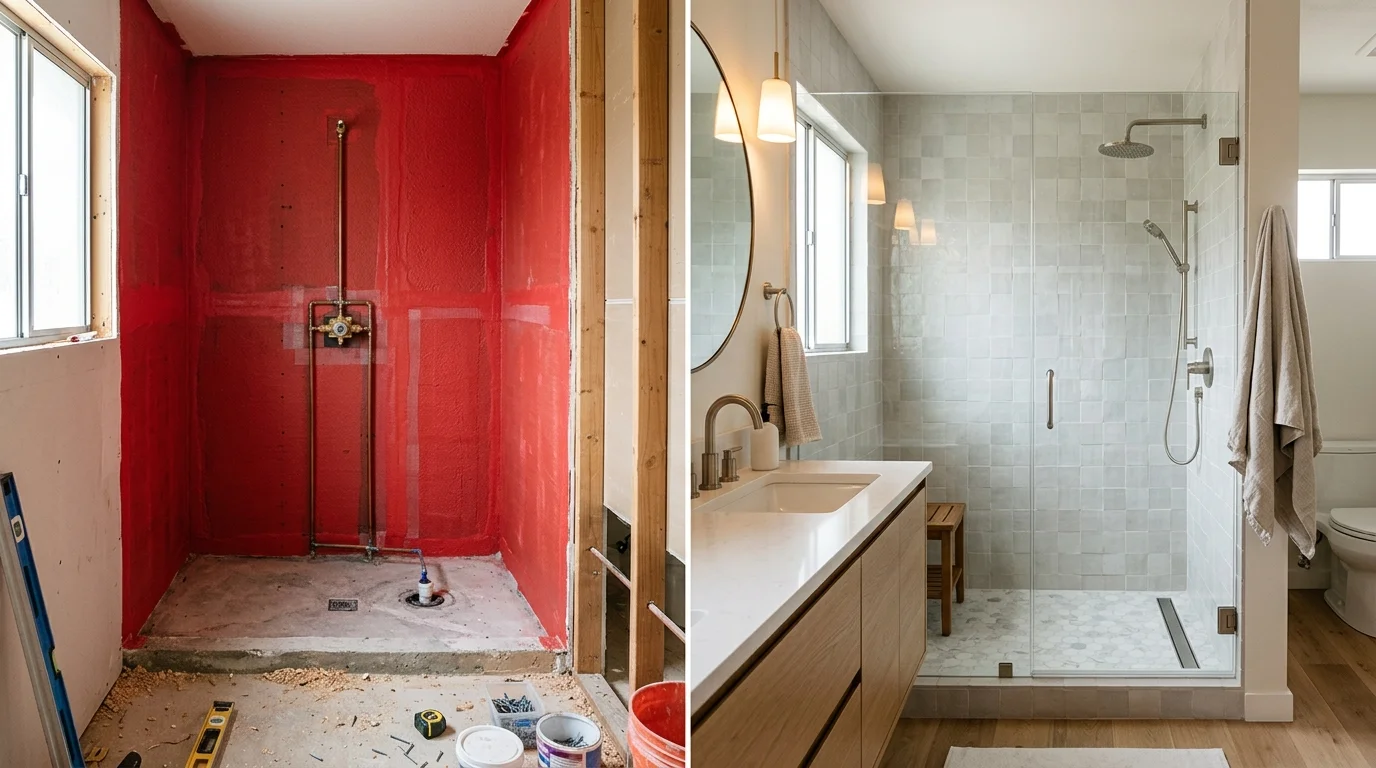
The tile you see in a San Diego shower is the finish. Waterproofing is the system under it: the pan, the membrane, the drain tie-in, and every corner. After demolition, that is the decision that keeps water out of the floor and the studs. Grout will not do that job. Neither will a pretty layout.
If the last shower stained a Mission Valley ceiling, or a Clairemont curb has been recaulked twice, the failure is behind the tile. Bath Pro SD matches homeowners with licensed independent bathroom remodelers. We do not install, inspect, or warrant the work.
What waterproofing actually is, and why grout is not it
Water in a shower does not stay on the face of the tile. It moves through grout joints. It sits in pinholes. It rides hairline cracks at the corners. Tile is a wear surface. Grout is a spacer. Caulk is a flexible joint. None of those is a tank.
Waterproofing is the continuous layer that catches that water and sends it to the drain. It runs on the walls, across the floor, over the curb, into the niche, around the valve, and into the drain. If that layer has a gap, water finds it. Then it finds the backer, the studs, and sometimes the unit below.
Cement backer board is not bathroom tile waterproofing. It is a substrate. Some boards handle moisture better than drywall. That is still not a membrane. A hardware-store coating rolled onto old drywall in a 1970s Clairemont bath is not a shower system either.
Slope comes first so water cannot pond. Then the membrane or liner. Then, if the installer does one, a flood check. Then tile. If you skip to tile because the bathroom tile buying guide already picked a stone, you are decorating a leak.
That is why a shower remodel in San Diego County is less about the glass and more about what disappears after the last grout wipe. Walk-in showers, benches, and niches add corners. Corners are where assemblies fail.
In stacked condos from Downtown to Mission Valley, a missed detail does not stay in one bathroom. It shows up as a stain on someone else’s ceiling. In a single-story El Cajon ranch, it shows up as a soft subfloor and a smell you cannot place.
Sheet membranes, liquid membranes, and traditional pan liners
Three families show up in San Diego showers. They are not swap-in parts. They are different ways to make a tank. The shower waterproofing membrane only works if it is continuous and tied to the drain the way that system was built.
Sheet membranes
Fabric or polyethylene sheets bond to the walls and floor. Seams get sealed with the matching band or thinset the maker specifies. The drain is usually a bonding-flange type so the sheet can tie in without a hidden liner under the mud. Homeowners often hear this as shower pan liner vs Kerdi. Kerdi is one product in a sheet class. What matters is continuity, the drain match, and whether the niche and bench are in the same system.
Liquid membranes
These are coatings rolled or troweled on. They look simple. The drawbacks are real. Thickness is easy to miss at inside corners. Pinholes hide in a hurried coat. The coating has to be compatible with the thinset and the board. A liquid membrane is not a shortcut around slope, drain detailing, or curb wrapping. If an installer cannot tell you how the product is supposed to be built up, and how they check coverage, keep asking.
Pan liners and hot mop
A PVC or CPE liner sits in the pan, clamped to a drain, with a mortar bed on top. Walls still need their own treatment. A nail through the liner, a fold that is too tight, or a drain that is not clamped will leak under the mud, where you cannot see it.
Hot mop is the older Southern California method: asphalt and felt built up in the pan. It is still used here. Layer counts, cure rules, and what a local inspector wants were not confirmed in our source review. Do not treat a sales pitch as code. Ask the licensed installer what they are building, and ask the building department that covers the address.
No system is waterproof by name. A sheet with an open corner fails. A liquid with a thin curb fails. A liner with a screw through it fails. Niches, benches, curbs, and later holes for glass hardware are where workmanship shows. For bathroom tile in a wet area, the membrane and the setting materials have to be a matched assembly, not leftover buckets mixed on site.
Coastal humidity vs inland hard water: two failure patterns
San Diego County is not one climate.
Along the coast in Pacific Beach, La Jolla, Ocean Beach, and Point Loma, the marine layer keeps bathrooms damp long after the water shuts off. Salt air sits on hardware and grout. Water that gets behind tile does not dry the way it would in July in Ramona. Small membrane gaps stay wet. Mold in a wall cavity can get a head start before paint shows a stain. Coastal showers also fog glass and metal. People blame the door. The assembly behind the tile is still wet.
Inland, El Cajon, Escondido, Santee, and the unincorporated stretches around Lakeside and Alpine run hotter and drier. Hard water leaves scale on grout and glass. Scale hides failed caulk. Heat and cool nights move the building. Caulk tears at the curb and at the corner where the pan meets the wall. Homeowners recaulk. The leak continues under the tile because caulk was never the membrane.
Both patterns look like a grout problem first. They are not. Grout can be stained, sandy, or missing and still not be the leak path. The leak path is the missing or punctured layer behind it.
Older East County slabs and 1960s coastal cottages add another twist. Some showers were built with a pan and little or no wall membrane. Some were tiled over greenboard. A “refresh” that sets new tile on those walls puts a new finish on an old failure.
If you live in the City of San Diego, permit questions go to Development Services. Unincorporated addresses go through County Planning and Development Services. Poway, Del Mar, Encinitas, Chula Vista, El Cajon, Oceanside, and the other incorporated cities run their own departments. Whether a shower needs a permit depends on scope. A trigger list and a fee schedule were not confirmed here, so do not act on a blog checklist. Call the department that covers your lot.
Flood tests and what a licensed installer should show you
A flood test is simple in idea. The drain is plugged. The pan holds water. You watch. If the level drops, or a ceiling below darkens, the pan is not ready for tile.
How long that water should sit, and whether your jurisdiction requires the test, could not be confirmed from the code sources this site is allowed to cite. Do not accept a number from memory or from a forum. Ask the licensed installer what they will do on your job. Then ask the City of San Diego Development Services Department, County Planning and Development Services, or your city’s building department whether they want to see it.
What you can insist on without a code citation is visibility. Before tile covers the assembly, you should see slope that sends water to the drain, not into the corners. You should see a drain connection that matches the system, a clamping ring or a bonding flange, not a smear of caulk. The membrane or liner should wrap the curb, not stop on the inside face. Inside corners should be treated, not painted around. The niche should be part of the wall membrane, not a box set into a hole. The bench should shed water and tie into the same layer. Pipe and valve openings should use that system’s own details. Dated photos of the open work should be on your phone.
California treats bathroom remodels as home improvement work. A licensed contractor is required when the job is not a minor exemption. As of January 1, 2026, that exemption applies only when the aggregate contract is under $1,000 and no permit is required. Splitting a job to stay under that number is not allowed. Acting as a contractor without a license is a misdemeanor. Confirm the person at your door on the CSLB license lookup.
On a home improvement contract, the down payment cannot exceed $1,000 or 10 percent of the contract amount, whichever is less. On a large shower job that cap is $1,000, not 10 percent of the whole number.
A countywide price to waterproof a shower, or to re-waterproof one after a leak, could not be confirmed. Size, demo, whether walls come off, the system, and what is already wet all change the number. Ask for a written scope. Do not shop a viral average.
The day-to-day of setting tile is a separate sequence. What happens during shower tile installation is the finish pass. Waterproofing is the pass you cannot redo without tearing that finish off.
Signs the last shower was never waterproofed
Some showers tell on themselves.
Loose tile at the floor, especially in a ring around the drain, often means the mud bed or the pan has been wet for a long time. Soft or stained drywall on the other side of a shower wall is not a paint issue. A ceiling stain under a second-floor bath in North Park, or in a La Jolla condo stack, is the classic downstairs report.
Musty air that returns after you clean is a moisture source, not a product problem. Grout that crumbles, then crumbles again after a recaulk, is water moving behind the face. Dark, soft wood on the outside of the curb, or a swollen vanity side next to the shower, is the same story.
A previous owner who “just replaced the tile” without opening the pan is a common San Diego pattern. New porcelain on an old, unwaterproofed wall looks fine for a season. Then the same leak returns, prettier.
You cannot confirm a missing membrane from the hallway. Confirmation is demolition, or a careful opening at a failed curb or corner by a licensed pro. Meters and cameras can hint. They do not replace seeing the layer.
If the shower is still in daily use and you only have stains, stop flooding it while you get help. Recaulking is not a plan. When the walls come open, that is the moment to build the membrane correctly, not to patch and close.
When to call us
If you are opening a shower, replacing a leaking pan, or planning a tiled walk-in, you want a licensed bathroom remodeler who will show you the waterproofing before the tile goes on. Call us at (858) 400-4896 and we’ll connect you with a licensed local bathroom remodeler.