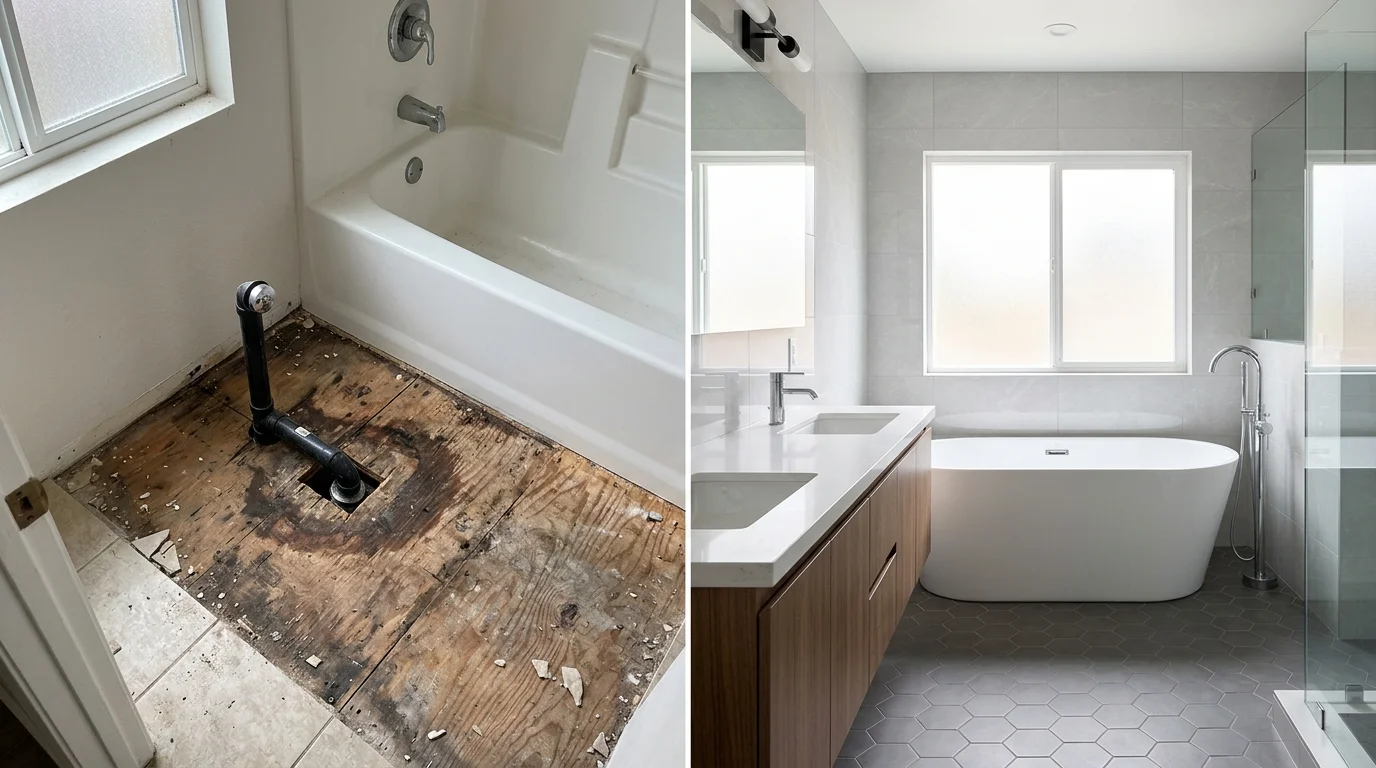
Tile comes up on day two of a full bathroom remodel, and the plywood under the tub gives like a sponge. That bathroom floor soft spot is the moment the new finish has to wait. Bathroom subfloor repair in San Diego is the wood (or the slab topping) under the vinyl or tile: rot, bounce, and whether a toilet or tub can sit again.
What a soft spot under vinyl or tile usually means
A soft spot is the finish reporting on the layer below it. Vinyl can hide a lot. So can a sheet of tile that still looks fine. You feel it at the toilet, at the tub apron, or in the path from the shower to the vanity. The floor compresses a little. A tile edge lifts. The toilet rocks after you sit down.
That usually means the subfloor has taken water long enough to swell, delaminate, or rot. In a bathroom the wet spots cluster around fixtures. The toilet flange. The tub overflow and shoe. The shower curb. The valve wall. A supply nick inside a vanity. Once water is in the wood, it travels along the panel and along the joist bays. The stain you see after demo is often smaller than the damage a licensed local pro finds with a knife and a moisture meter.
A rotted bathroom subfloor also shows up as sound. Squeaks that started after a slow leak. A hollow knock next to the tub. Cracked grout that keeps coming back in the same field. Those are finish failures with a floor problem underneath. Putting new bathroom tile on a bouncing panel just moves the crack into next month’s grout.
What it does not tell you, by itself, is how far the damage runs. A Pacific Beach cottage with 1/4-inch vinyl over old plywood can feel spongy in a two-foot circle and still have sound joists. An El Cajon hall bath can feel solid under ceramic and still have a mud bed that stayed wet for years. The only honest next step is a test opening. The licensed installer cuts a window in the finish, checks the panel, and keeps cutting until the wood (or the slab) is dry and solid. Span tables, panel thickness, and a “typical” patch size could not be confirmed for this page. Those calls belong to the person standing over the opening, and to the building department that will look at the job if a permit is required.
Cost is the question people ask first. Bath Pro SD has no verified price, average, or “starting at” figure for bathroom subfloor repair, and we do not publish one. Square footage, access, whether the tub has to come out, and whether joists are involved all move the number. A licensed local pro prices the floor after they open it. Anyone quoting a full replacement from the hallway, before demo, is guessing.
Raised-floor vs slab: two different repair paths
San Diego County is not one floor system. Coastal north and the beach cities still have a lot of raised wood. Inland East County and many postwar tracts sit on slab. Bathroom subfloor repair follows that split.
Take a Pacific Beach cottage. Many of those houses are small, close to the marine layer, and built with a crawl space or a low belly. The bathroom floor is plywood or older board over joists. Salt air and wind-driven rain work the west and south walls. A leak at a tub, a shower, or an old aluminum window wets the panel from above. Damp air in the crawl can wet it from below. The repair path is carpentry: pull the finish, cut back to solid wood, check every joist you can see, sister what is lost, and sister only after the leak is dead. Then new panels, fastening the installer specifies, and a floor that can take tile or vinyl without bounce.
Now take a hall bath in El Cajon. A lot of those rooms sit on a slab. There are no joists to sister. What fails is the topping: a mud bed, a backer, an underlayment, or the slab surface itself after years of a weeping shower curb or a failed toilet wax. The licensed local pro is reading the slab and the wet layers stuck to it, not a crawl. Repair can mean grinding, patching, a new underlayment the tile setter accepts, and a dry slab before anything bonded goes down. Inventing a patch mix, a thickness, or a cure time would be a guess. Confirm the product and the prep with the installer, and confirm any permit question with the City of El Cajon building department (El Cajon is its own city) or, if the house is in an unincorporated pocket, with County of San Diego Planning & Development Services.
Access changes the job as much as the structure. A raised floor you can see from a crawl is easier to diagnose than a second-story bath in a Clairemont or North Park house, where the only view is from above. A slab hall bath is easier to open and harder to dry if water has been sitting in a mud bed. Neither path is “better.” They are different houses, different moisture, different repair.
Unlicensed structural patching is a bad bet. In California it is a misdemeanor to act in the capacity of a contractor without a license, unless a narrow exemption applies. The current exemption is for casual, minor work under $1,000 that does not need a permit. Both conditions have to hold, the $1,000 figure is the one in effect as of January 1, 2026, and splitting a job to stay under the number does not count. Anyone who advertises as a contractor loses the exemption at any price. Check the person you hire on the CSLB license lookup.
Joists, sistering, and when the tub has to come out
Once the panel is gone, the licensed local pro is looking at the framing. On a raised floor that means joists. Dark staining on the top edge. Soft wood you can push a screwdriver into. A bay that smells like a wet cabinet. Sistering is the common repair: a new member fastened alongside the damaged one so the floor has a solid bearing again. How long the sister runs, what size it is, and how it is fastened are not figures we can publish. They were not in our verified ledger. The installer opens the bay, the homeowner asks to see the damage, and the City of San Diego Development Services or the county or city department for that address is who confirms whether the repair needs a permit. We did not fetch a trigger list or a fee, so we will not invent one.
The tub is the expensive complication. To replace subfloor under a bathtub, the tub usually has to come out. You cannot cut a sound panel under a cast-iron or acrylic tub that is still sitting on the damage. You cannot sister a joist that dies under the tub shoe if the tub is in the way. A toilet is the smaller version of the same problem. A rocking toilet is often a rotten ring of plywood around the flange. The bowl comes up, the flange is inspected, and the wood is replaced before a new wax and a new set. A plumber may handle the drain and the reset. The wood is carpentry. On a full remodel, the licensed bathroom remodeler coordinates both so the toilet is not set on a patch that still moves.
People ask whether a plumber “does the subfloor.” Sometimes a plumbing company will cut and patch a small ring at the closet flange. Widespread rot, joist work, and a floor that has to take tile again belong with the remodeler running the room. Bath Pro SD matches homeowners with licensed, independent local pros. We do not pull the tub, sister the joists, or set the toilet.
When the tub is out, look at the same time at the overflow, the shoe, and the valve. Those are how water got into the floor in the first place. A new panel under a still-weeping overflow is a short story. Drain and sewer issues below the floor are a separate surprise, and they are covered in our note on drain and sewer surprises in a bathroom remodel. This page is the wood. If the waste line is the next problem, that post is the one to read.
Moisture from the shower pan vs a leak at the window
Two wet stories show up over and over in San Diego bathrooms, and they look similar after the fact: a dark bloom in the plywood. They are not the same leak.
A shower pan leak wets the floor from the wet side of the room. Water gets under the finish at a cracked curb, a failed seal at the drain, a cut membrane, or a pan that was never detailed. It runs to the lowest point, which is often the toilet or the tub. Coastal houses with a shower on an exterior wall can also drive moisture into the same bay from the window. That is a different path: wind-blown rain at Pacific Beach, Ocean Beach, and La Jolla, salt on the frame, a failed track, and a sill that drains onto the subfloor instead of outside. Inland, a window leak is less about salt and more about a badly flashed opening or a crack in the wall above the sill. The floor still rots. The repair still fails if you only change the plywood.
The licensed local pro has to name the source before they close the floor. Dye on a shower floor. A hose on the window. A look at the paper and flashing if the wall comes open. If the shower is the source, the pan and the wet walls are the real job, and the floor is the damage they left. How a shower is waterproofed is its own sequence, and we keep that on shower waterproofing in San Diego. This page will not retell membranes. It will say this: a new subfloor under a shower that still leaks is wasted wood.
A toilet wax, a supply stop, and a tub overflow are the other usual sources. None of them need a made-up percentage. If the wood is wet, find the water, dry the bay, then repair. Closing a damp bay behind new tile is how the next owner gets a soft spot in two years.
Mold smell in a closed bathroom is a reason to open the floor, not a reason to paint. We do not have a verified lifespan for plywood in a wet bath, and we will not print one. Dry wood that is still sound can stay. Wet, delaminated, or crumbly wood comes out. That is the whole rule.
How a licensed local pro scopes the floor before tile goes back
A good scope happens before the tile order is final, because the floor decides the height of every fixture. The licensed local pro should:
Walk the existing finish and mark every soft spot, crack, and rocking fixture. Photograph the toilet, the tub apron, and the shower curb. Ask how long the room has smelled musty, and whether a window has ever stained the sill.
Open a test area at the worst spot, not at a pretty corner. Keep opening until the cut lands on dry, solid material. On a raised floor, look at the joists from above and, if there is a crawl, from below. On a slab, look at the topping and the slab surface, and do not tile until both are dry enough for the setting materials the installer will use.
Name the water source and write it into the contract as work that has to finish before the new panel is closed. Shower pan, window, toilet, tub, or a supply leak. If the source is in the wall, the wall comes open too.
State what comes out: finish, underlayment, subfloor panels, and any joist work. State whether the tub or toilet has to come out to do it. “Best” subfloor material is a product call the installer makes for that room. Moisture-resistant plywood is a common bathroom choice. A specific thickness, brand, or span could not be confirmed here. Ask to see the panel stamp and confirm it with the installer. If a permit is in play, confirm with City of San Diego Development Services for a city address, or with County Planning & Development Services for unincorporated county. Incorporated cities (Poway, El Cajon, Chula Vista, Encinitas, and the rest) run their own building departments.
Put the floor back so it can take the finish you actually want. Tile wants a stiff, flat plane. Vinyl is more forgiving and still fails on a trampoline. The tile setter should see the new floor before the first sheet of bathroom tile is set. Height changes at the bathroom door, at the shower curb, and at the toilet flange all get checked the same day.
On a home improvement contract in California, the down payment cannot exceed $1,000 or 10 percent of the contract amount, whichever is less. On a large remodel the cap is $1,000. Check the license on CSLB before you sign. Bath Pro SD refers. The matched local pro does the work and stands behind that work.
When to call us
Call when the bathroom floor moves, the toilet rocks, or demo has already shown stained or soft wood and the new tile cannot go back yet. That is licensed bathroom remodeling work, and it is the kind of stop that belongs in a full remodel, not a weekend patch. Call us at (858) 400-4896 and we’ll connect you with a licensed local bathroom remodeler.