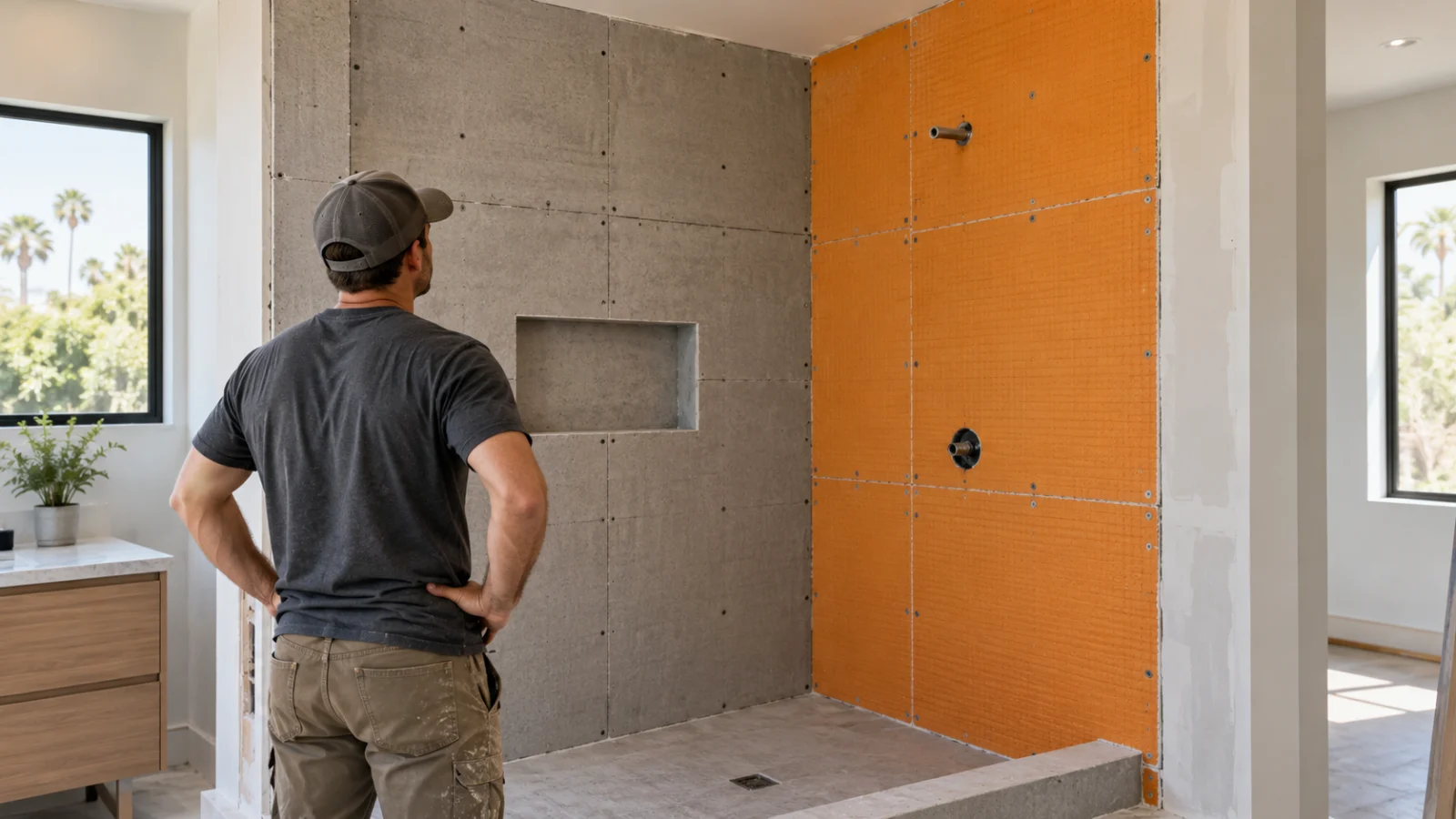
Cement board and foam backer board can both support tile in a shower. They do not create the same assembly. The useful question is not which board wins in isolation. It is whether the remodeler’s written scope explains the board, the waterproofing layer, and every transition that will disappear behind the tile.
Bath Pro SD connects San Diego County homeowners with licensed independent remodelers. We do not install tile, specify a system, or replace the manufacturer’s current instructions.
The short answer
Choose the complete system that the installer can name, document, and build correctly.
USG describes Durock cement board as water-durable, but not waterproof. A shower using cement board therefore needs a separate, compatible waterproofing plan for the wet area.
Schluter describes KERDI-BOARD as a reinforced foam tile substrate that can become part of a bonded waterproofing assembly. That claim depends on the suitable treatment of seams and joint areas. A foam panel with unfinished connections is not a complete shower system.
This distinction matters more than the color or weight of the board. Tile and grout are finishes. The layer behind them has to manage water continuously.
What cement board contributes
Cement board gives tile a rigid, water-durable substrate. It is familiar to many tile crews and appears in shower, tub-surround, wall, floor, and countertop specifications.
Water durability is not the same as waterproofing. USG states that Durock itself is not waterproof. Its guidance points to a waterproofing membrane when materials behind the board need protection. That means a cement-board bid should identify the membrane separately.
Ask the remodeler to name:
- The exact cement board
- The waterproofing product that works with it
- How the written system handles corners, seams, the valve, and other penetrations
- Which current manufacturer instructions control the work
Those questions do not tell the installer how to build the shower. They make the scope checkable before tile hides it.
Read the USG Durock product page and USG wet-area guidance when a bid names that product.
What foam backer board contributes
Foam backer board combines the tile substrate and part of the waterproofing strategy in one product family. Schluter says KERDI-BOARD uses an extruded-polystyrene foam core, reinforcement on both faces, and fleece webbing that anchors the tile-setting material.
Schluter also says the panels can form a bonded waterproofing assembly when the abutting seams and joint areas receive the suitable system preparation. That condition belongs in the conversation. The panel face alone does not explain how two boards meet or how the system turns a corner.
A foam-board bid should name:
- The panel and its selected thickness
- The matching components used at seams, corners, and penetrations
- The waterproofing treatment around the shower base, niche, bench, and valve
- The manufacturer instructions the installer will follow
Different foam systems use different components. Do not assume one brand’s seam treatment applies to another brand.
Schluter’s KERDI-BOARD product page identifies the material and available panel range. The manufacturer’s current handbook should control the actual installation.
Compare the bids, not two loose samples
A showroom sample does not show the risky parts of a shower. The hard decisions sit at changes in plane and openings in the assembly.
Put two proposals side by side. Each should make these items visible:
- Substrate. What exact board supports the tile?
- Waterproofing. Is it a separate membrane or part of a named panel system?
- Connections. What system covers seams, corners, penetrations, and the shower base transition?
- Complex features. How are the niche, bench, curb, and window included in the same assembly?
- Documentation. Which current manufacturer literature governs the work?
- Open-wall proof. Will the contractor provide photos before tile covers the system?
If one bid says only “install backer board and tile,” it leaves the most important layer undefined. Ask for the missing product names and scope before comparing totals.
Our shower waterproofing guide explains the membrane decision in more detail. The shower tile installation guide covers the larger work sequence. This page stays focused on the substrate choice between those steps.
Where San Diego homes make the scope harder
The board choice does not change because a home is in San Diego. The surrounding conditions can change what the installer has to coordinate.
A condo shower may share walls or floors with another unit. A niche can compete with plumbing in a narrow wall. A shower window creates another opening in the wet area. An older tub alcove may be out of square after demolition.
These conditions do not prove one backer board is better. They are reasons to demand a complete drawing or written scope instead of a category name. A licensed remodeler should inspect the open framing and confirm that the chosen manufacturer system fits the actual shower.
Permit requirements depend on the complete project scope. City of San Diego homeowners can confirm jurisdiction and current requirements through Development Services. Unincorporated addresses use County Planning & Development Services. Incorporated cities run their own building departments. We do not publish a trigger checklist because the verified source record does not support one.
Red flags before the tile arrives
Pause the decision if the proposal treats grout as waterproofing, calls bare cement board waterproof, or names a foam panel without its matching connection details.
Also pause if the contractor will not identify the product until installation day. Product substitutions can change the rest of the assembly. A written change should explain the new board, membrane, and compatible components before the wall closes.
Do not ask a remodeler to mix leftover products just because each label uses the word waterproof. A system claim applies to the assembly the manufacturer describes, not any combination of materials on the truck.
When to call us
If your shower is open, leaking, or ready for new tile, call (858) 400-4896. We will connect you with a licensed independent bathroom remodeler who can inspect the space and write the complete backer-board and waterproofing scope.