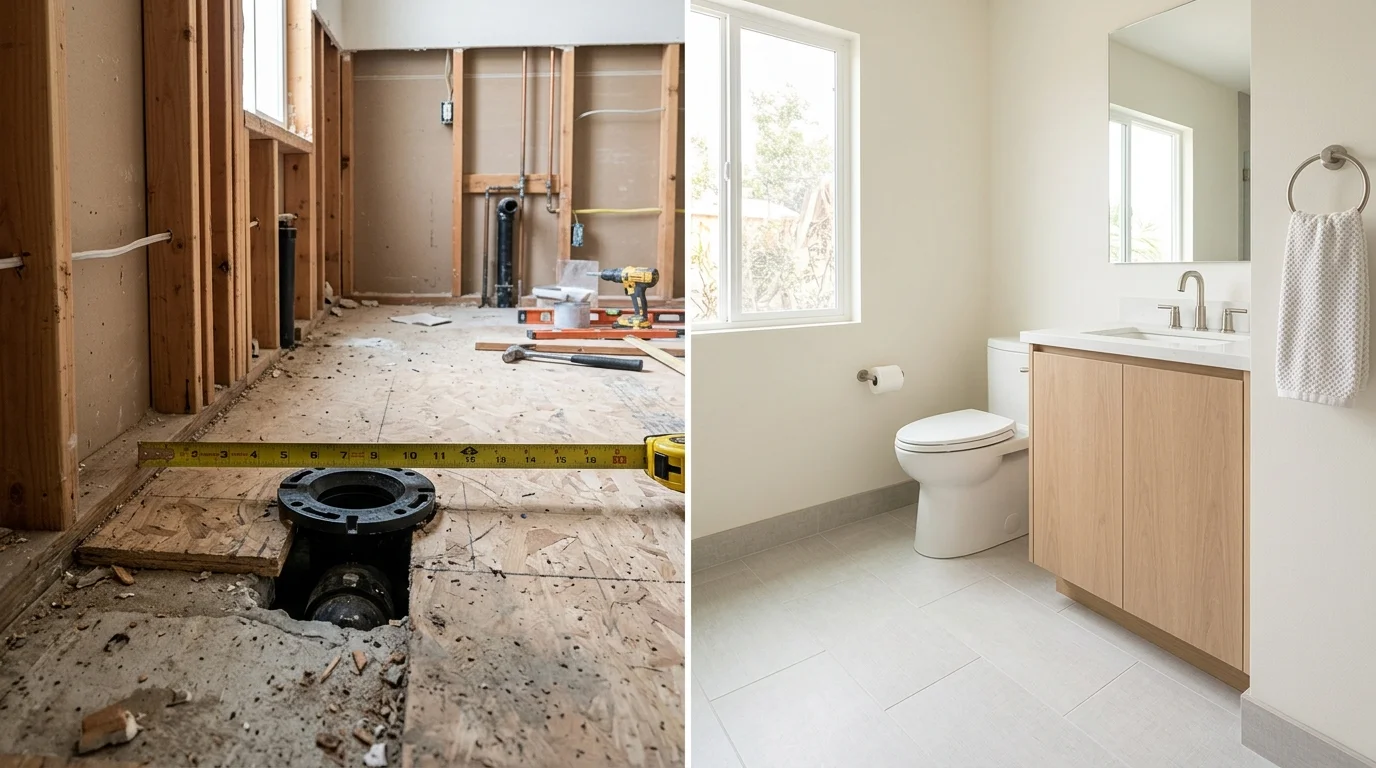
The toilet on the showroom floor is almost always a 12-inch rough-in. The closet flange in a compact San Diego hall bath may sit closer than that. Buy the wrong bowl and the tank jams the wall, or the bowl sits too far into the room and the wax ring never seals.
What rough-in distance is, measured from the finished wall
Rough-in is the distance from the finished wall behind the toilet to the center of the closet flange. The flange is the ring that bolts the bowl to the soil pipe. You measure to the center of that ring, or to the midpoint of the two closet bolts if the toilet is still sitting.
Measure from the finished wall, not from the baseboard. Base trim sits proud of the paint or tile. Counting it shortens the number and sends you to the wrong bowl. Measure from the surface the tank will actually face: drywall, tile, or wainscot.
If the bath is open to studs, the tape reading is not the finished rough-in yet. Drywall, backer board, and tile all add thickness. A flange set twelve inches from the studs can land closer to eleven once the wall is tiled. The bowl has to match the finished number, not the stud number.
A 12-inch rough-in is the size most new toilets are built for. A 10-inch rough-in toilet is a bowl whose outlet is built ten inches from that finished wall. A 14-inch rough-in is the long version, used when the flange sits farther out. Those three families are how you match a new toilet to an existing flange.
To measure for a replacement, shut the water off and look at the closet bolts from above. Tape from the finished wall to the midpoint between the bolts. If the old toilet is already out, tape from the wall to the center of the flange opening. Write the number down before you shop. The carton will say 10-inch, 12-inch, or 14-inch. That label has to match what you measured.
Some 12-inch bowls have a little play under twelve inches. How much play lives on that model’s spec sheet, not on a rule of thumb. Do not assume a 12-inch bowl will sit on an 11-inch flange. If the tape reads ten, buy a 10-inch rough-in toilet. If it reads twelve, buy twelve. If it reads fourteen, you are in the 14-inch family.
The supply stub on the wall is a separate layout. A published inch figure for that stub-out could not be confirmed here. Confirm it with the licensed plumber on the job. If the house is inside the City of San Diego, Development Services is the department that handles building permits for that address. Side and front clearances for a private home were not confirmed in our claims file either. Ask the local building department for the number that applies to your lot. Do not copy a national blog’s inches onto a San Diego permit set.
Why older San Diego tract baths often sit on a 10-inch rough-in
Twelve inches is what the big-box aisle is stocked for. A lot of older tract hall baths in the county were plumbed tighter than that. You still see a 10-inch rough-in in Mira Mesa, El Cajon, and Oceanside tract baths, especially in the small hall bath that sits between two bedrooms. That is a pattern, not a countywide rule. The next house on the same block can be a clean 12-inch. Measure yours.
Those hall baths were laid out to fit a tub, a small vanity, and a toilet on a short wall. The soil stack often lands close to the back wall because that is where the joists and the wet wall allowed it. A 10-inch rough-in toilet was the bowl that sat on that flange without the tank hitting the wall. When the original two-piece finally fails, the replacement on the shelf is a 12-inch. That mismatch is the whole problem.
East County and inland North County housing stock is not the same as a coastal master bath. A Mira Mesa 1970s hall bath is a different room from a newer Carlsbad primary. The compact plan, the thin finish, and the original flange location are why the 10-inch still shows up. Oceanside tract baths from the same era have the same squeeze. El Cajon hall baths do too. None of that means every toilet in those cities is a 10-inch. It means you tape it before you buy.
Two bathrooms in the same house can disagree. The hall bath can sit on ten inches while the primary sits on twelve or thirteen. That is not a mystery. Different walls, different stacks, different finish thickness. Measure each flange on its own. Do not order two 12-inch bowls because the master looked standard.
If you are already opening the room for a full bathroom remodel, the licensed plumber can talk through whether the existing flange stays. For a toilet-only swap, the cheaper, cleaner path is almost always a bowl that matches the flange you have.
Offsets, thicker finishes, and when the toilet will not sit
The toilet will not sit when the finished wall has moved closer to the flange than the bowl was built for. Tile laid over old tile is a common San Diego shortcut in hall baths. Stone, a thick wainscot, or a second layer of backer does the same thing. The tank ends up flush to the wall. The closet bolts will not tighten. The wax ring never compresses evenly, and the bowl rocks.
An 11-inch reading is the awkward middle. A 12-inch bowl is too long for that wall. A 10-inch bowl will sit, but it leaves extra space behind the tank and the bowl projects farther into the room. That extra inch in front can pinch a tight hall bath. It is still a real option when the flange cannot move.
A licensed plumber may talk about an offset closet flange. That fitting shifts the bowl a small amount without relocating the soil pipe. Whether it is a sound repair depends on the stack, the floor, and the offset itself. A hard turn on a soil line is a clog waiting to happen if the fitting is the wrong type or the wrong amount. That is a field call, not a product-page promise. In an upstairs bath or a slab, the plumber may tell you the offset is a poor idea and the bowl should match the pipe.
Do not count on the plumber “making a 12-inch fit” on an 11-inch flange. Forcing the tank against new tile is how the last install started leaking at the tank bolts. If the finish is going on after the flange is set, tell the plumber the finish thickness before the pipe is glued. Leave the finished-wall number at twelve if that is the bowl you want. Adding tile later without that conversation is how a 12-inch rough-in becomes an 11.
If the bowl rocks, stop. A rocking toilet is a wax-ring failure in progress. Shims can level a slightly uneven floor. They do not fix a rough-in that is the wrong family. Resetting the same 12-inch bowl on a 10-inch flange will look the same in a week.
Matching the bowl to 10-inch, 12-inch, or 14-inch flanges
Match the bowl to the flange. That is the whole buying decision on a toilet swap. A 12-inch rough-in toilet is the common SKU. A 10-inch rough-in toilet is a real product line, not a special-order unicorn, though the aisle will be thinner. A 14-inch rough-in is the long specialty size. Fewer models are tooled for it, and they often cost more for that reason. No dollar figure belongs on this page. Compare cartons and spec sheets, not a guess.
Read the spec sheet, not the marketing photo. Two bowls that look the same height can have different outlets. Comfort-height and standard-height are seat measurements. They do not change the rough-in family. A senior who wants a taller seat still needs the 10-inch or 12-inch outlet that matches the flange. The ADA Standards set water closet seats at 17 to 19 inches above the floor for public facilities. That is the benchmark accessible residential work is built to. It is not a legal requirement for a private single-family home. Rough-in is still the wall-to-flange number.
If you are shopping for aging in place, pick the seat height you want, then confirm the rough-in on that exact model. Do not buy a 12-inch comfort-height bowl for a 10-inch flange and hope the extra porcelain hides the gap. The tank will tell on you.
Bring the tape number to the store. If the old toilet is still in, photograph the bolts and the wall. If the bath is a compact hall bath in Mira Mesa, El Cajon, or Oceanside, assume nothing and measure anyway. Ask the seller for the 10-inch version of the bowl you like before you fall for a 12-inch floor model.
The water supply, the side wall, and the door swing still have to work with the bowl you pick. Those clearances are set by the local building department, not by this page. For a house in the city, start with San Diego Development Services. For unincorporated communities, County Planning and Development Services is the agency. Incorporated cities run their own building departments. Look up your address before you treat a national clearance chart as local law.
When moving the closet flange is a plumbing remodel, not a toilet swap
Keeping the flange and matching the bowl is a toilet replacement. Moving the closet flange to chase a 12-inch bowl is a different job. The drain has to move. The floor around it has to open. On a slab that can mean cutting concrete. On a wood floor it can mean sistering, patching, and a new flange set to the finished wall you actually want. That work is moving fixtures in a bathroom remodel, not a Saturday bowl swap.
Do that only when the layout has to change. A vanity going wider, a door that clips the bowl, or a plan that needs the toilet off that wet wall are real reasons. Wanting the floor-model 12-inch because the 10-inch aisle looked thin is not. Once the drain moves, you are in bathroom plumbing rough-in territory. A licensed plumber does that work. Bath Pro SD matches you with that pro. We do not set flanges, pull permits, or own a pipe wrench on your job.
Whether a given move needs a permit turns on scope, and the trigger list was not confirmed here. Do not guess. Ask the building department that has your address. City lots go through San Diego Development Services. Unincorporated lots go through County Planning and Development Services. Poway, El Cajon, Oceanside, Chula Vista, and the other incorporated cities run their own counters.
If the soil line, the vents, or the supply are already failing, moving one flange will not fix the rest of the bath. That is a repipe conversation, and it belongs in the same visit as the toilet decision. Opening the floor once is better than opening it for a flange, then again for a galvanized supply.
Anyone who acts in the capacity of a contractor without a license, unless exempted, commits a misdemeanor under California law. Check the plumber on the CSLB license lookup before anyone opens the floor. For home improvement contracts, the down payment cannot exceed $1,000 or 10 percent of the contract amount, whichever is less.
When to call us
Call when the tape and the carton disagree, when tile has eaten the rough-in, or when the only way to get the bowl you want is to move the closet flange. That is licensed plumbing on a bathroom, not a retail swap. Call us at (858) 400-4896 and we’ll connect you with a licensed local bathroom remodeler.